Driving Sim Handbrake Based on Load Cell
Summary
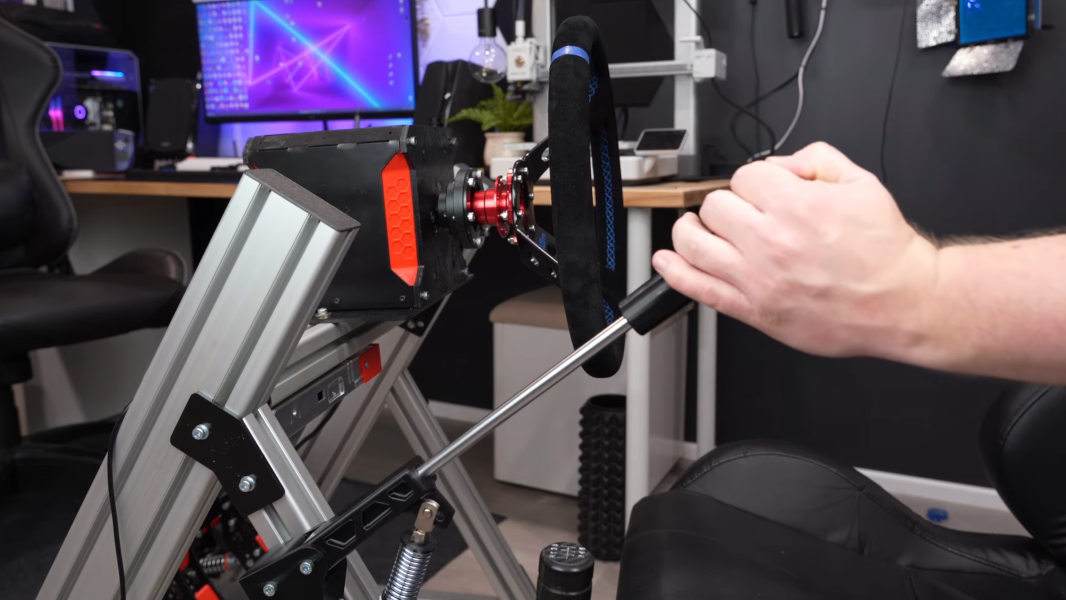
Simulator-style video games offer varying complexity, allowing players to engage casually or with detailed realism. [CNCDan] enhances his DIY driving sim rig with a lever-style handbrake, showcasing innovative design and impressive hardware for an authentic racing experience.
Key Insights
What is a load cell and how does it work in a sim racing handbrake?
A load cell is a sensor that measures the force or weight applied to it. In a sim racing handbrake, the load cell detects the pressure exerted on a lever connected through a spring mechanism, converting that physical force into an electronic signal. This allows the handbrake to provide precise, force-based input rather than simple on/off detection, enabling more realistic control that mimics how a real handbrake responds to driver input. The signal is processed by a microcontroller (such as an Arduino) and sent to the computer as joystick or controller input.
Why would someone build a DIY handbrake instead of buying a commercial one?
Building a DIY handbrake allows sim racers to customize the design to match their specific needs and aesthetic preferences, integrate it seamlessly with existing custom hardware (like custom pedals and shifters), and potentially reduce costs. DIY builds also offer the flexibility to choose materials—such as 3D-printed or laser-cut components—and to fine-tune mechanical properties like lever angle and resistance. For enthusiasts like [CNCDan], creating a cohesive, personalized sim rig that replicates racing as faithfully as possible is part of the appeal of the hobby.
Sources:
[1]