Hubble Telescope Spots Strange, Massive Disk 40 Times the Size of Our Solar System
Summary
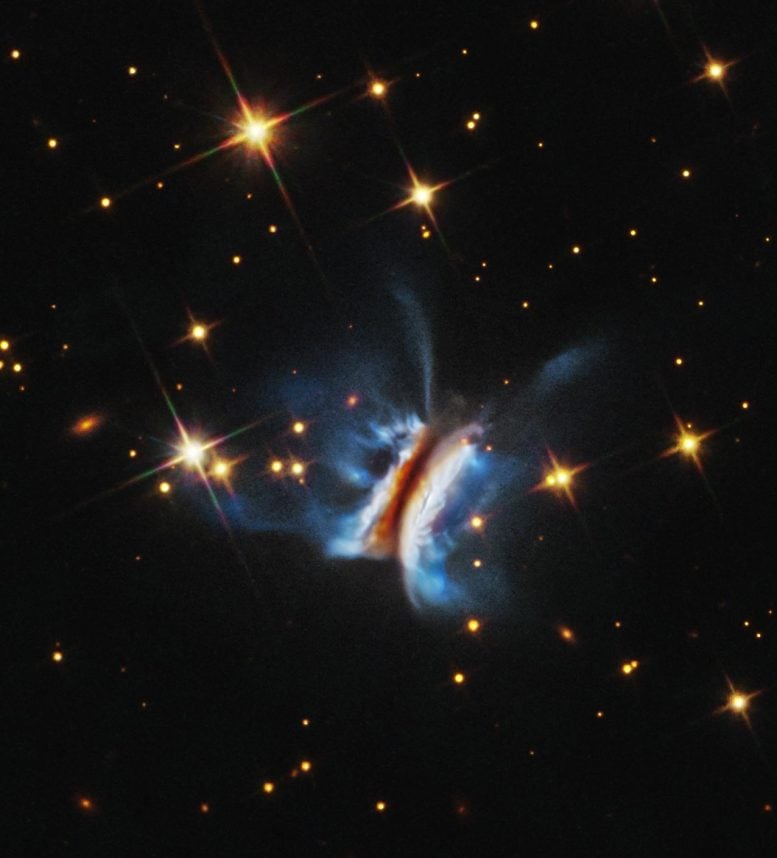
NASA's Hubble Space Telescope has unveiled the largest protoplanetary disk ever observed, challenging existing theories on planetary system formation. This turbulent disk surrounding a young star offers new insights into the chaotic processes of planet development.
Key Insights
What is a protoplanetary disk and why is its size important?
A protoplanetary disk is a rotating disk of dense gas and dust surrounding a young, newly formed star.[2] These disks are the birthplaces of planets, where tiny dust grains collide and stick together to form larger bodies through a process called accretion.[1] The size of a protoplanetary disk is significant because it determines the region available for planet formation and influences how many planets can develop. A disk 40 times larger than our solar system provides an exceptionally vast area for planetary system development, which challenges existing theories about how quickly and efficiently planets typically form.[3]
How do planets actually form within these disks?
Planet formation begins when microscopic dust grains—typically a few microns across—collide and stick together through random interactions.[1] The stickiness of these grains depends on their composition; icy grains are much stickier than bare rocky grains, making planet formation more efficient in cooler regions of the disk where ices can condense.[1] As particles accumulate, they grow into larger bodies called planetesimals and eventually planetary cores.[3] Once a core reaches a critical mass of a few times Earth's mass, it can rapidly acquire a massive atmosphere and form a giant planet like Jupiter or Saturn.[3] The entire process typically takes millions of years, with the disk itself lasting up to 25 million years before dispersing.[2]